
Artist’s Spotlight
Pandy Aviado: Revelations
Artist
The Imahica Art Team sat down with one of the gallery’s featured artists, Pandy Aviado, a prolific figure in Philippine printmaking whose artistic journey spans decades. Known primarily for his masterful print works, this feature offers a look into a different side of his practice, one that is deeply personal, experimental, and rooted in the vibrant creative energy of the 1980s.
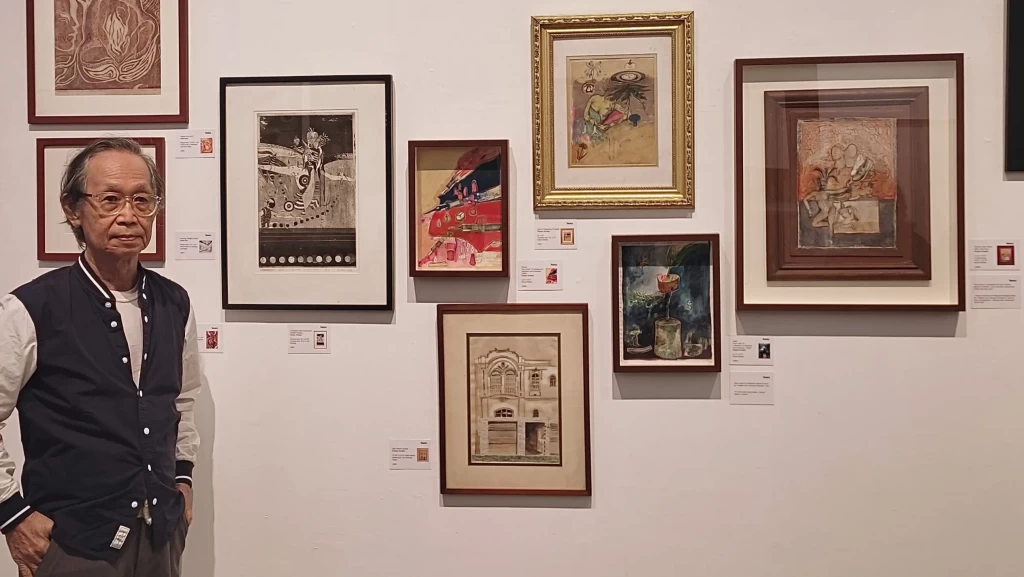
Freedom in Art
Stemming from a desire to create “something you haven’t seen before,” these works serve as a kind of Rorschach test for the viewer. During this period, Aviado collaborated with the late National Artist for Literature, Rolando Tinio, whose poetic sensibility intertwined seamlessly with Aviado’s visual rhythm. Their collaboration produced a myriad of one of a kind pieces.

Mixed Media, 11.5” x 8.5”, 1980s
With words by Rolando Tinio: “If a tree trunk could speak, it would speak in leaves. ”

Mixed Media, 11.5” x 8.5”
With words by Rolando Tinio at the back: “Bottle for Jeannie. Trunk for Houdini. The larger bottle is for both Jeannie and Houdini in case they want to escape from it all. ”
In Sibol, Tinio’s words accompany Aviado’s organic forms: “If a tree trunk could speak, it would speak in leaves.” The phrase captures the vitality and renewal that flow through Aviado’s mixed media compositions, where each line seems to grow and breathe. Similarly Baul 5, Tinio’s playful imagination finds visual echo in Aviado’s textured surfaces. At the back of the work are Tinio’s words: “Bottle for Jeannie. Trunk for Houdini. The larger bottle is for both Jeannie and Houdini in case they want to escape from it all.” These literary fragments mirror Aviado’s visual language, spirited and layered with rhythm and motion.
Aviado spoke most in-depth of Women Who Write With Their Feet, a piece Tinio described as a metaphor for the creative genius of women, suggesting that they could “write with their feet.”
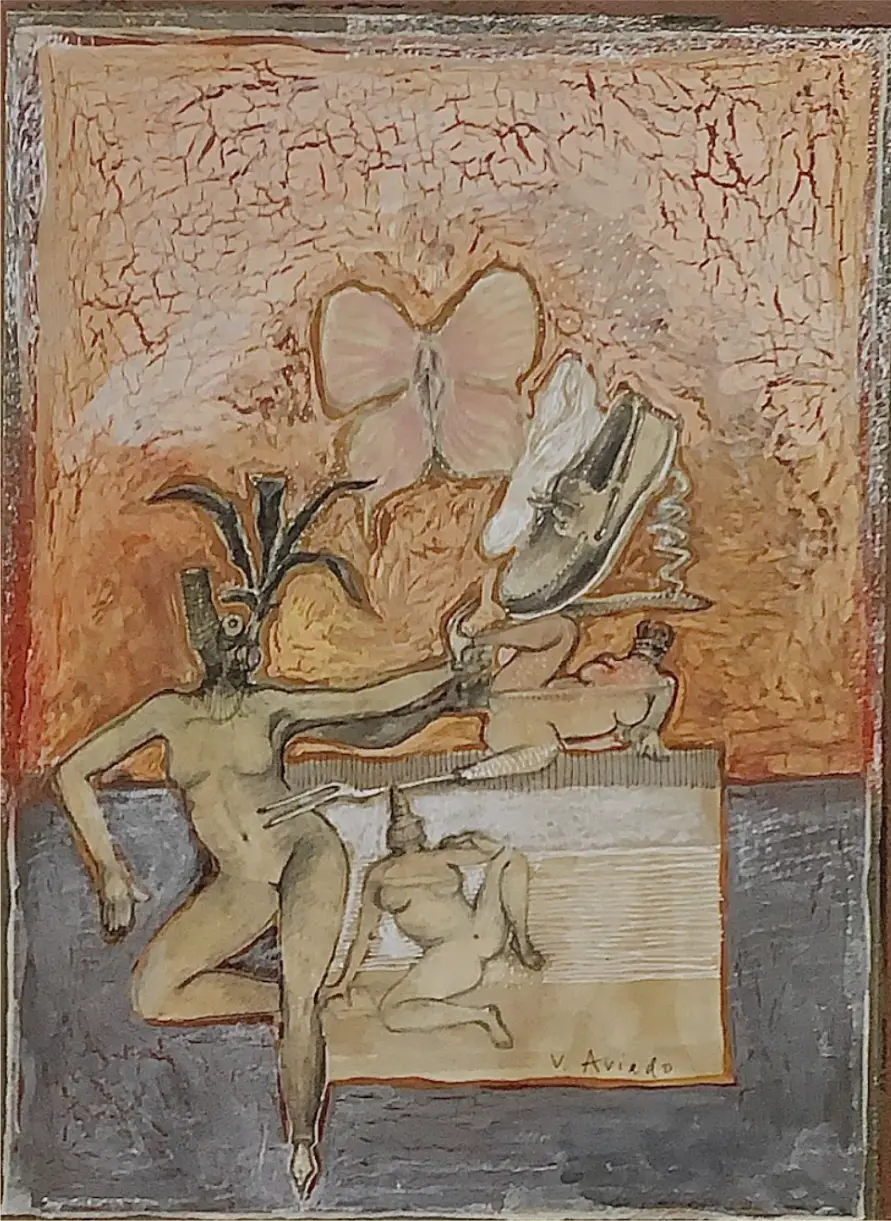
Mixed Media, 11.25” x 8.5” (With Frame 16.5” x 13.75”), 1980s
Aviado recalls working in an almost trance-like state during this time, allowing images to form spontaneously as he melded creatures and objects, both organic and inorganic. He began with charcoal to emulate the texture and tonality of lithographs, enriching each surface with cracked patterns and earthy hues that evoke a sense of age and continuity. The result is a visual language that feels ancient yet alive, abstract yet undeniably human.
Creative Macrocosm
What sets these works apart from his other collections is their freedom from commission or external direction. “They’re different, like how my fingers are different,” he mused, describing each piece as a fragment of a larger creative cosmos. These works were opportunities to explore without constraint, guided purely by instinct and subconscious rhythm. They embody his belief that art is not just expression but revelation, a process of discovering what already exists within.
Neverending Inspiration
Many of the pieces in this collection took years to complete, evolving over time as Aviado revisited and refined them. He considers some of them ongoing, describing them as drafts for future works or as vessels for continued exploration. What sustains his creative momentum, he explains, is art’s power to “heal memories” and restore vitality. For Aviado, creating is both a meditation and a form of renewal. As long as he is able, he intends to keep producing, continually finding new ways to translate emotion, thought, and memory into form.
From this period also came his collaboration with Rolando Tinio, an exchange of ideas that fused poetry and image, intellect and intuition. Together, they underscored how art, in any form, can transcend boundaries and speak across disciplines.
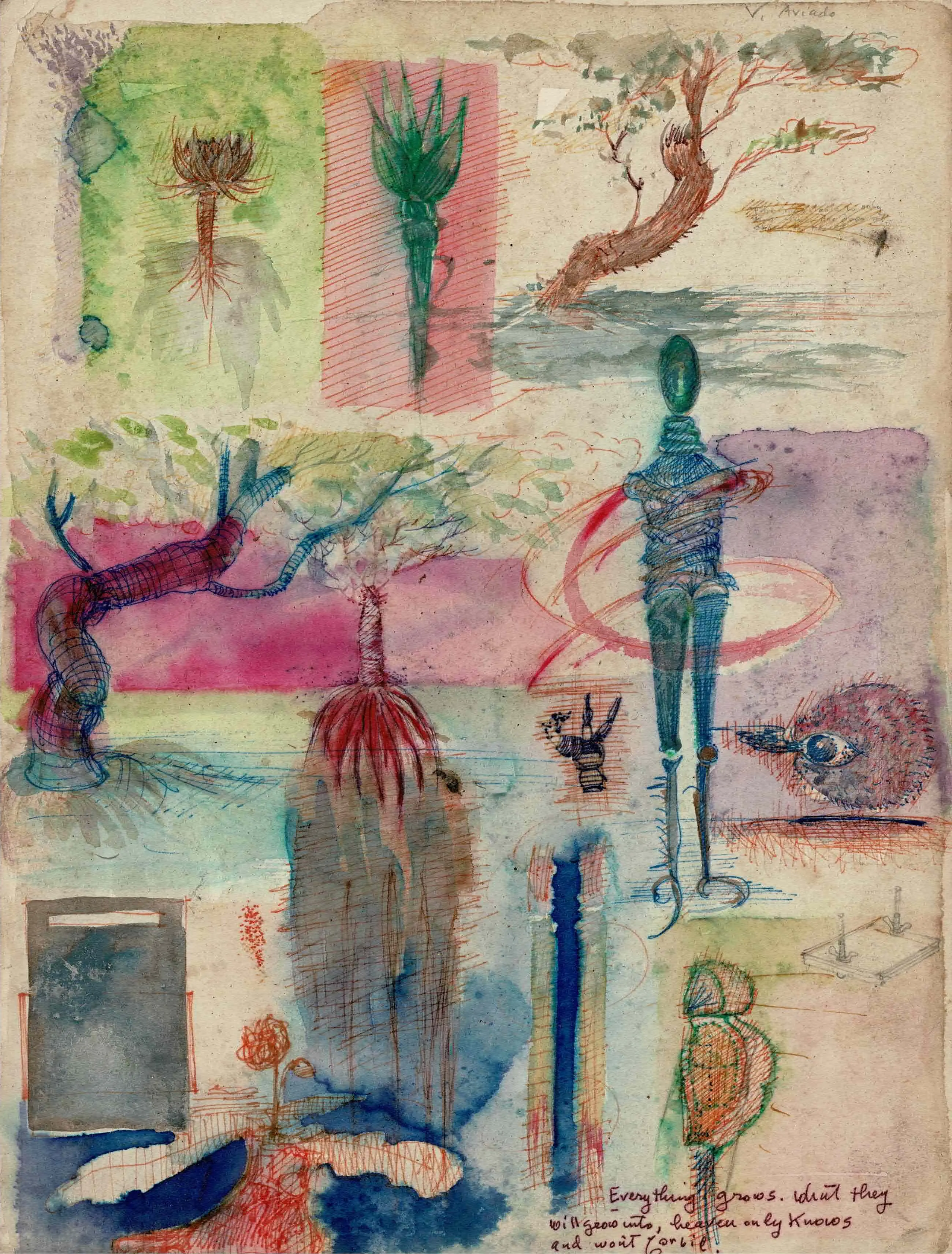
Mixed Media, 11.5” x 8.5”, 1980s

Mixed Media, 11.7” x 8.3”, 1980s
